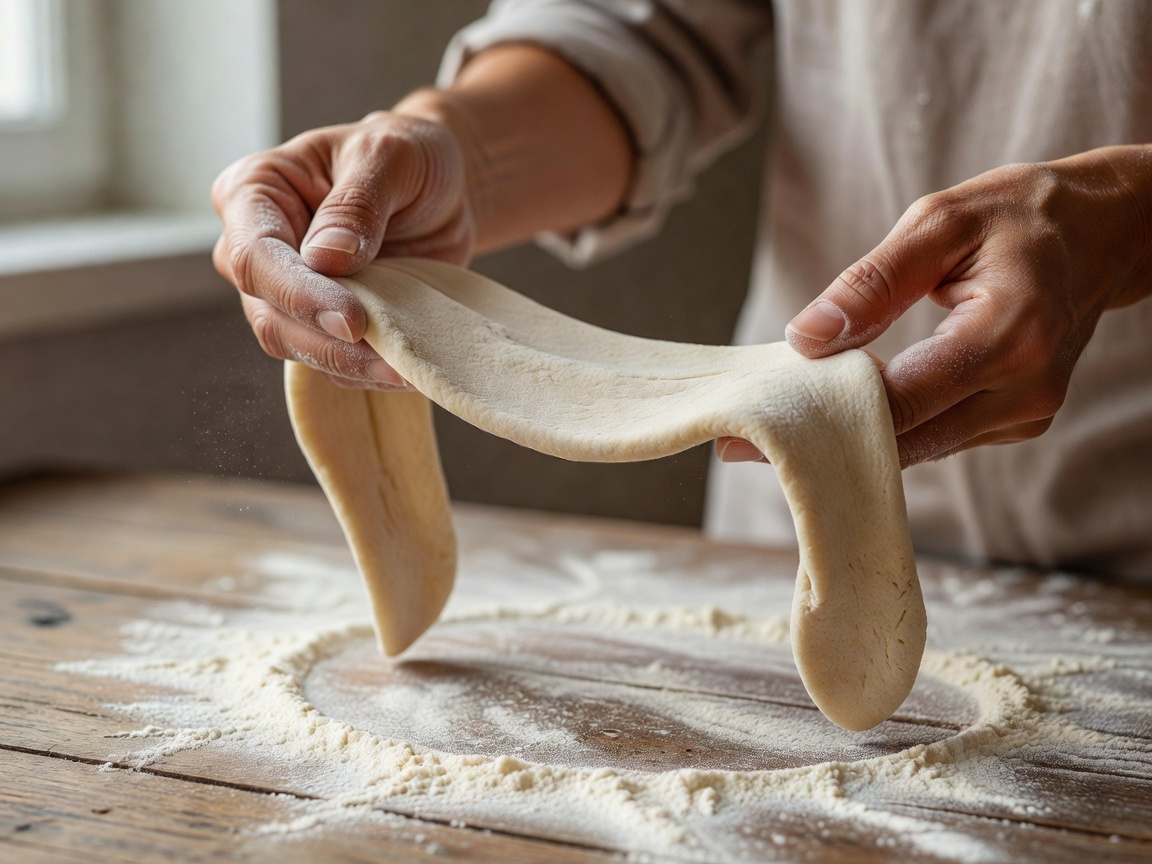
Start with a measurable baseline
For a simple practice dough, weigh 200 g of plain all-purpose wheat flour, 100 g of water and 2 g of salt. This is a starting exercise, not a universal formula for ramen, udon or hand-pulled noodles. Different flours absorb different amounts of water, and the same flour may behave differently in a humid kitchen. Keep a few grams of water available for small corrections rather than pouring freely.
Read the flour label and note its protein content if provided. Wholemeal flour, durum semolina and finely milled plain flour do not behave identically. Do not substitute gluten-free flour directly into this exercise: its structure requires a purpose-designed formulation. Raw flour can carry harmful microorganisms, so do not taste raw dough; clean your hands and work surface after handling it.
Mix until the evidence changes
Dissolve the salt in the water, then work the liquid through the flour with chopsticks, a fork or your fingers. At first you will see damp crumbs and dry patches. Squeeze a handful. If it holds together, continue gathering rather than adding water immediately. If loose flour remains after thorough mixing and compression, add water in very small measured increments.
Bring the mixture into a firm mass and cover it for about 20 minutes. Return and press it again. The surface should feel more unified because water has had time to distribute. Knead gently for several minutes, using the heel of your hand and folding the dough back on itself. Avoid forcing an exceptionally stiff dough through equipment not designed for it.
Recognise relaxation
Cut off a small piece and try rolling it. If it shrinks back strongly but does not crumble, cover the dough and give it another 15–20 minutes. Tightness and dryness can look similar until you test them. Dry dough often cracks at the edges or refuses to join; tense dough can be smooth yet resistant. A rest helps tension, while genuinely dry dough may need a small hydration adjustment.
Do not aim for a bread-style windowpane as a universal noodle test. The relevant question is whether your dough can be rolled to the intended thickness without excessive cracking or spring-back. Cover unused portions so that surface drying does not create a second problem while you solve the first.
Roll for even cooking
Divide the dough into manageable pieces. Flatten one piece, roll from the centre outwards and rotate it often. Use only enough dusting flour to prevent sticking; heavy dusting can make the surface dry and cloud the cooking water. Feel across the sheet with your fingertips. A thick centre and paper-thin edges will not finish cooking together.
For this first exercise, aim for a roughly 2 mm sheet and cut strips of similar width. The exact width is less important than consistency. Dust the cut surfaces lightly, separate the strands and keep them loosely arranged. If they stick into a mass, do not yank them apart; separate gently and reconsider whether the sheet was too wet or insufficiently dusted.
Cook a test before the batch
- Bring a generous pot of water to a boil and cook two or three test strands.
- Stir gently at the start so the noodles do not settle together.
- Remove a strand, cool it enough to handle safely and taste. Seek a cooked centre without a raw flour taste.
- Record the time as a guide for this thickness, then cook the remaining noodles in manageable batches.
A hard centre can mean insufficient cooking or excessive thickness. A soft exterior with a stubborn centre may point to uneven rolling. Change the most likely cause on the next small sample rather than cooking the entire batch longer without checking.
Understand the regional boundaries
Japanese udon, Italian tagliatelle, Chinese lamian and Korean kalguksu show how ingredients and shaping methods create different textures. Egg pasta introduces another source of water and protein; alkaline ramen noodles add chemistry that this plain dough does not reproduce. Do not add household cleaning chemicals or guess at alkaline additives. Use food-grade ingredients and a tested specialist recipe when moving beyond this baseline.
Carry one observation forward
Write down the flour, added water, rest periods, approximate thickness and cooked texture. Repeat once with only a longer rest. When you can explain that difference, practise pan finishing with noodles whose texture you already understand.
Continue to heat control